
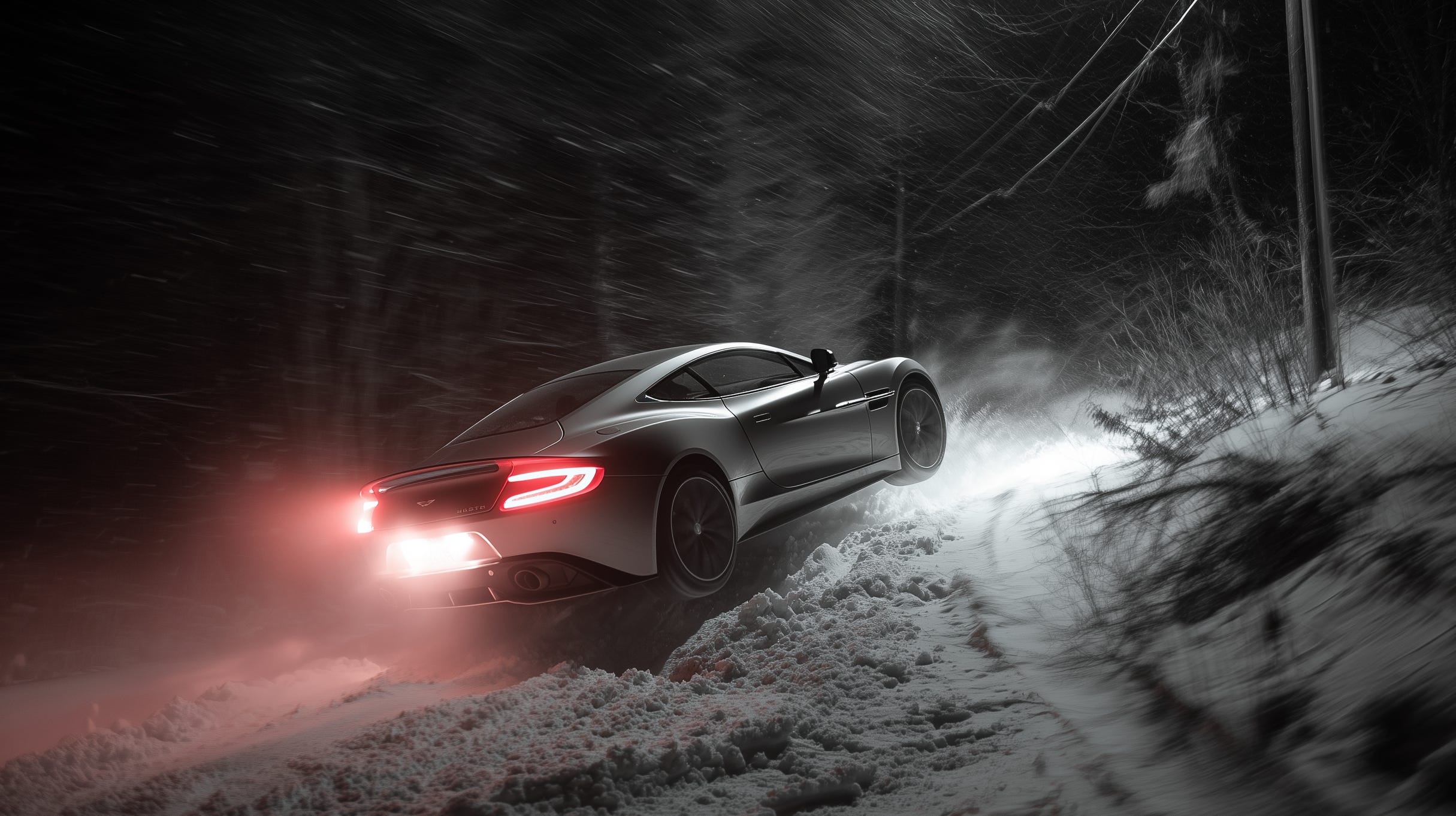
Under the Wire
The road was a black ribbon that had turned to grease.
Royston drove. He was headed to a dinner at the lodge, a meeting where the wine would cost more than the average man’s monthly rent and the conversation would be about acquisition. He wore a heavy wool suit that fit him like armour. He looked the part of a man who moved things, a man who decided.
The hospital badge was still on the passenger seat, the paper curling at the edges from his hand. His mother’s name was printed in a clean font. Under it, his own, written quickly, the signature he used when he didn’t want to feel anything.
He kept seeing the room in flashes. The bright panel in the ceiling. The thin blanket folded back. The plastic rail of the bed under his palm when he leaned in. Her hand on his knuckles, light but deliberate, as if she were keeping him from leaving too fast.
He had said, “I’ll be back soon,” and the sentence had come out smooth. She nodded once. He watched her do it and felt the nod land inside him.
He hadn’t looked at the monitor when he left. He’d looked at the door.
The lodge was a climb away. He pictured it anyway: warm wood, low light, faces turned in, laughter arriving a beat late. The partners’ smiles were wide and empty. Teeth. Cheeks. No eyes. They would say his name and clap his shoulder and ask about the quarter and not ask about anything that could break them.
His phone lay face down in the console. It had been face down for days. A name lived behind his ribs. A city across the ocean. He could see the thread with her, the last message sitting there like a stone. He’d typed three different openings in the elevator earlier and erased them all. He could calm a room full of executives with one sentence and still couldn’t send a small truth to a woman who used to know his real face.
He pressed the accelerator.
The Aston answered cleanly. The needle climbed. The cabin stayed steady. The dash glowed with perfect geometry. The heater filled his sleeves with warm air.
Underneath, the slush kept chewing. Thud. Scrape. Thud.
He drove faster and let the road become something he didn’t have to think about.
The mountain narrowed. Pines closed in. The world turned to headlight and snow and the thin strip between them. The traction light blinked once on the dash. He saw it and didn’t ease off. He wanted the lodge behind him before he arrived. He wanted to be done with it before it began.
He tried to picture the meeting, the big partners, the deal structure, the polished sentences, the moment he would be expected to speak like a machine that made people feel safe.
His mind refused. It kept returning to the hospital. It kept returning to the text he wouldn’t send. Two burdens, both quiet, both heavier than they should have been.
The slush thickened. The tires started to feel less like tires and more like skates.
The squall hit.
It wasn’t a gradual thing. It was a wall. White poured across the windshield and the trees vanished and the shoulder vanished and the whole world became a small tunnel his headlights could not hold.
The wipers worked and did nothing.
He leaned forward. His jaw tightened. His hands went hard on the wheel as if force could turn luck into physics.
The steering went thin.
Not the drama of a movie. A softness. A moment where the car stopped biting and started floating.
The Aston began to plane on packed slush, lifting on a cushion of freezing mud. It felt almost smooth. It felt like being forgiven.
Then the road ended.
The scraping stopped for a heartbeat as the car left the asphalt.
The ditch took it.
The nose dipped and the chassis shrieked against frozen earth. A limb snapped with a sharp crack. The car slammed to a stop at an angle that made the dash look crooked.
He sat with both hands on the wheel and listened to his own breath.
Something slid across the roof. A wire, dragged down with the limb, came to rest above him.
The hum began.
Low. Electric. Steady.
The dash lights fluttered once. The radio clicked on by itself, spit static, and died. He smelled hot dust. He tasted metal.
His phone had no signal.
He tried the door. It opened a crack and held, pinned by snow. The hum thickened, not louder, heavier.
He stayed still long enough for his mind to begin making bargains.
Wait. Don’t move. Someone will come. The lodge will send a driver. You’ll be late but you’ll arrive. You’ll sit down and laugh and everything will go back to the way it was.
Then he saw a thin haze curling from the hood, barely visible in the dim light of the cluster.
The machine was warming in the wrong place.
He unbuckled. He didn’t stand. He didn’t slide out like a man stepping from a car in a valet lane.
He jumped.
A clean hop away from the door, feet together, like he was leaping a puddle.
His soles hit the snow and a sharp jolt snapped through him, quick and ugly. His jaw clenched. The world flashed. It wasn’t enough to knock him out. It was enough to teach him.
He dropped to one hand and pulled it back as if the ground had teeth.
He kept his feet close and shuffled away in short steps, not wanting to become a path. His suit dragged in the snow. The wool drank slush. His breath came loud.
When he’d gone far enough that the hum felt less like it was inside his skull, his legs finally gave up.
He went to his knees.
He crawled then, palms into snow, moving the way you move when you no longer care what you look like. The road was only white and wind. The Aston sat crooked behind him, humming under the wire, perfect and useless.
His thoughts came in hard bursts.
His mother. The badge. The nod.
The lodge. The smiles. The empty laughter.
The girl’s name. The message he wouldn’t send. The childish fear of being ignored.
It was all there at once, stacked, and he felt the pressure of it in his chest, like something trying to climb out.
A shape appeared ahead at the edge of the headlights’ reach.
A woman stood in the road.
No coat. Hair still. Snow did not land on her shoulders.
He stopped crawling. His hands sank into the drift. His mouth opened and no sound came.
She looked at him as if she’d been waiting for him to finally get down here, at this level.
She lifted her chin toward his pocket.
He understood without words.
He pulled out his phone with clumsy fingers. The screen lit his palm. A bar flickered. Two. One again.
His thumb hovered.
He didn’t craft anything. He didn’t try to be clever. He didn’t try to win.
He hit call.
The hospital answered. He said his mother’s name. He said, “Tell her I’m coming back,” and the sentence came out rough and plain.
He ended the call and opened the thread with the girl’s name.
Three words.
I miss you.
He hit send before his fear could reach his hand.
He looked up.
The woman was gone.
Only snow. Only the wind. Only the dim tunnel of his headlights cutting into nothing.
He didn’t chase the shape. He didn’t ask what it meant. He couldn’t afford to.
He turned his body away from the lodge and began to crawl back toward the road, then forced himself up into a careful shuffle, feet close, moving slow, keeping distance from the car and the wire.
Down the mountain, somewhere below the storm, there would be light and signal and another set of decisions.
He kept moving toward that.
Toward the rooms he avoided.
All stories published by Crowe are works of fiction created with artificial intelligence under human direction. Any resemblance to actual persons or events is purely coincidental.


